What tokens are in plain language — and why some languages cost twice as much
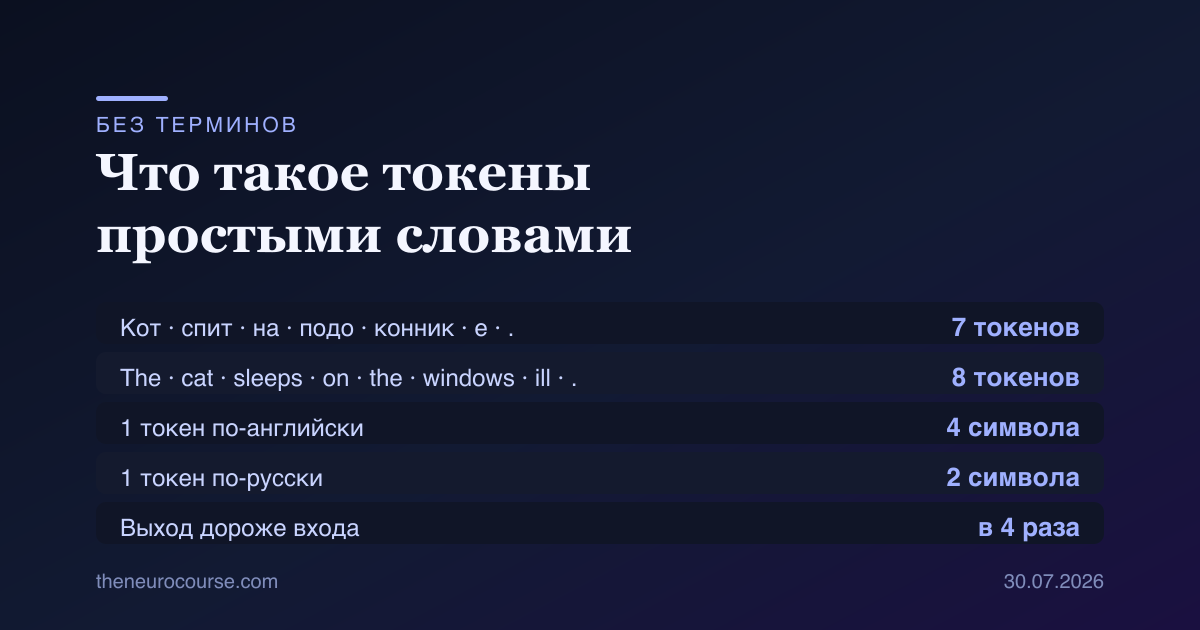
The short version: a token is a chunk of text a neural network operates on. Neither a letter nor a word: a common short word usually takes one token, a long rare one gets split into several. In English a token is roughly four characters; in many other languages it is closer to two. The practical consequence: the same thought outside English takes about twice as many tokens, so it costs more and runs slower. Below: how to see this for yourself, how input tokens differ from output tokens, and why a long conversation gets more expensive on its own.
Easier to see once
Take a sentence and cut it the way a model does. The vertical bar is a token boundary.
The cat sleeps on the windowsill.
→ The| cat| sleeps| on| the| windows|ill|.
8 tokens
The rule is visible. A common short word — "the", "cat", "on" — is a single token. A long or rare one gets split: "windows|ill". Punctuation lives as its own token. A space usually sticks to the word that follows it.
Now the same thought in Russian:
Кот спит на подоконнике.
→ Кот| спит| на| подо|конник|е|.
7 tokens — with half as many characters
Nearly the same token count for noticeably less text. That is the density gap: English is packed more efficiently, because models trained mostly on it and the token vocabulary was tuned for it.
The rule of thumb
In English 1 token ≈ 4 characters; in many other languages ≈ 2 characters. Budgeting, or working out whether a document will fit — double your estimate outside English.
This is not only about money. Token count decides whether your text fits the model's window at all, and how fast the answer arrives.
Tokens are counted twice: in and out
A conversation with a model is two portions of tokens, billed separately.
- Input — everything you send: the question, pasted text, a file, an image, the conversation history.
- Output — everything the model writes back.
The difference is not terminology but money: output costs several times more. With Gemini 2.5 Flash-Lite as of 30 July 2026, input is $0.10 per million tokens and output is $0.40. Four times.
Let us count. A 100-word question is about 300 input tokens — $0.00003. A 500-word answer is about 1,500 output tokens — $0.0006. The answer costs twenty times the question, even though you wrote yours yourself and the model produced its own in seconds.
Hence the rule that saves most: shorten the answer, not the question. A line saying "answer in one paragraph" cuts the bill more than halving your question. And "explain in detail, with all the examples" is the most expensive phrase you can write to a model.
Why a long conversation gets pricier every message
The model does not remember earlier turns. For it to follow the thread, the entire exchange is sent again — every time, from scratch. Your tenth message drags the nine before it along, and all of them count as input again.
Message 1: 300 input tokens.
Message 5: 300 of your own + 1,800 of history = 2,100.
Message 10: 300 of your own + 4,500 of history = 4,800.
You keep writing equally short replies while the input grows by itself. That is why a long everything-in-one thread costs more than a fresh chat with the same question — and why the model eventually starts losing the beginning of the conversation: the old text no longer fits.
The context window: where all of it piles up
Everything the model has available right now sits on one table — that is the context window. On it at the same time: the system instruction, the whole conversation history, any uploaded files, and room for the answer it is writing.
The size of that table is measured in tokens. By mid-2026 the top models are around a million: that is what Claude Sonnet 4.6 (in beta), Gemini and GPT-5.4 advertise. A couple of years earlier the standard was 128 thousand — eight times less.
A million tokens is roughly 2,500 pages of English text, or about 1,250 pages in a denser language. And that is for everything together: history, files and the answer.
An honest caveat you will not find in the marketing: the advertised window and the working one are different things. The model formally accepts a million tokens, but quality sags noticeably earlier — in the middle of a huge text it gets confused and finds things less reliably. The closer to the limit, the less you should trust the answer.
What to do with all this
- Cap the answer length explicitly. "Three sentences", "a list of five" — direct savings.
- New task, new chat. Cheaper and more accurate: stale context stops interfering.
- Do not upload a whole file when you need one section. Cut out the part that matters — the answer gets better, not just cheaper.
- Try long technical prompts in English. The token savings come as a bonus to the fact that models follow an English brief more precisely.
Where to see your own token counts
If you reach the model through an API, the response carries a usageMetadata block: the model itself reports how many tokens went in and how many came out, broken down by modality. That is the most honest way to check any calculation — including ours.
FAQ
What is a token in a neural network, in plain language?
A token is a chunk of text the model works with — neither a letter nor a word. A common short word usually takes one token, a long or rare one is split into several, and punctuation gets its own token. The sentence «The cat sleeps on the windowsill» becomes 8 tokens.
How many characters are in one token?
Roughly four characters per token in English, and closer to two in many other languages. The same thought therefore takes one and a half to two times more tokens outside English, and costs proportionally more.
Why does an AI cost more in languages other than English?
Models trained mostly on English text, and the token vocabulary was tuned for English. Other languages split into smaller chunks, so the same thought takes about twice as many tokens. Billing is per token, hence the price gap.
What is the difference between input and output tokens?
Input is everything you send the model: your question, files, the conversation history. Output is what it writes back. They are billed separately and output costs more: with Gemini 2.5 Flash-Lite it is $0.40 against $0.10 per million as of 30 July 2026.
Why does a long AI conversation get more expensive?
The model does not remember earlier turns — the whole exchange is re-sent with every message. Your tenth message drags the nine before it along, and they count as input tokens again. You write just as briefly while the input grows by itself.
What is a context window and how big is it now?
It is everything the model has available right now: the system instruction, the conversation history, uploaded files and room for the answer. It is measured in tokens. By mid-2026 top models are around a million — roughly 2,500 pages of English text. A couple of years earlier the standard was 128 thousand.
Does a million-token context window really work like a million?
No. The advertised window and the working one are different things. The model formally accepts a million tokens, but quality sags noticeably earlier: in the middle of a huge text it gets confused and retrieves less reliably. The closer to the limit, the more carefully you should treat the answer.
How do I reduce token usage?
Cap the answer length explicitly — output tokens cost four times input. Start a new chat for a new task, because the history is re-sent every time. Do not upload a whole file when one section will do. Write long technical prompts in English.