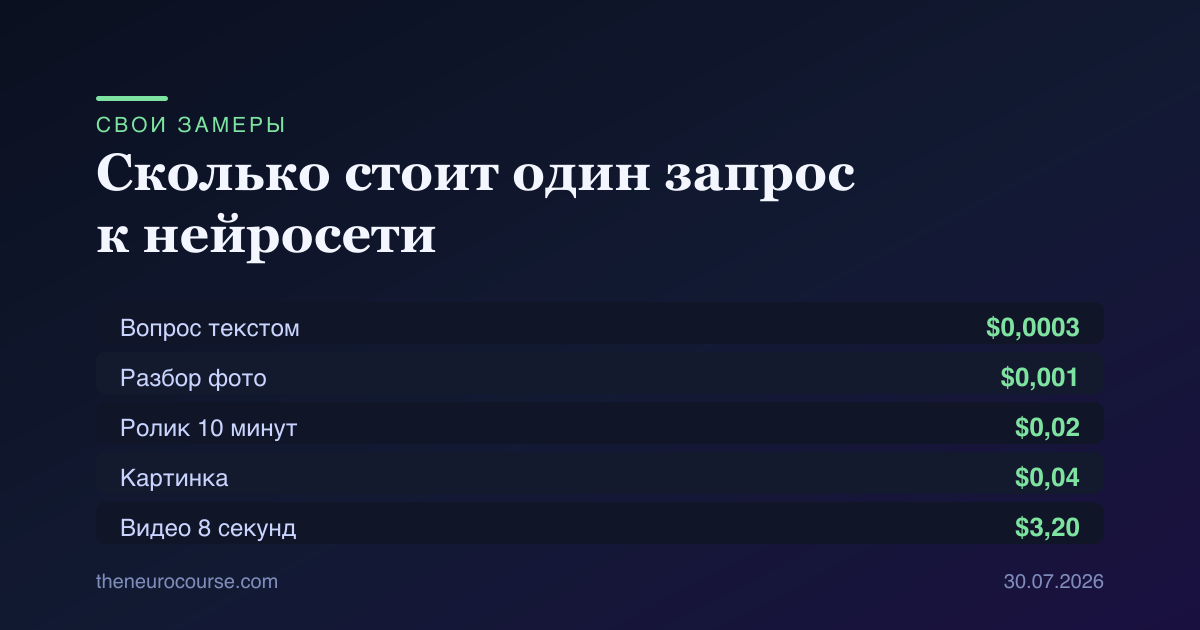
What one AI request actually costs: we measured nine operations
The short version: on 30 July 2026 we ran nine types of request through Google Vertex AI and logged the token counts straight from the API responses. The headline finding: reading is cheap for an AI, creating is expensive, and the gap reaches a thousandfold. Watching a ten-minute YouTube video costs two cents. Generating eight seconds of video costs three dollars twenty. Same technology, same bill, but operations of a completely different nature — and you cannot plan a budget without understanding that difference.
How we measured it
Not from calculators on marketing pages and not from vendor blog promises. Every request went to Vertex AI on our project's service account, and from each response we took the usageMetadata block — where the model itself reports how many tokens your input cost and how many its answer cost.
Then we multiplied by Google's published pricing as of 30 July 2026 for the Gemini 2.5 Flash-Lite family: $0.10 per million input tokens (text, images, video), $0.30 per million audio input tokens and $0.40 per million output tokens. Video generation prices come from the Veo 3.1 list: $0.40 per second in standard mode.
The method matters because it lets you repeat it: the same numbers sit in the response to any request you make, if you look at usageMetadata.
The table: what costs what
| Operation | What happens | Cost per run |
|---|---|---|
| A text question | ~300 tokens in, ~500 out | $0.0003 |
| Reading a photo | image plus a short answer | $0.001 |
| Transcribing 30s of speech | audio costs three times text | $0.0008 |
| Reading a paragraph aloud | speech synthesis | $0.0006 |
| Watching a 3-minute video | 51k tokens | $0.006 |
| Watching a 10-minute video | 171k tokens | $0.02 |
| Generating one image | 1,290 output tokens | $0.04 |
| 8s of video, fast mode | billed per second | $0.64 |
| 8s of video, standard mode | billed per second | $3.20 |
The finding: watching is cheaper than making
Compare two rows. Analysing someone else's ten-minute video: two cents. Generating eight seconds of your own: three dollars twenty. That is 160 times more for seventy-five times fewer seconds.
The reason is how billing works. Everything you send the model is input tokens — the cheapest thing on the price list. Everything it produces is output, and output costs several times more. With Flash-Lite, input is $0.10 per million and output is $0.40 — four times. Image and video generation are billed separately again, on entirely different rates.
Hence the rule that saves the most money: shorten the answer, not the question. A line saying "answer in one paragraph" cuts your bill more than halving your question does. The most expensive phrase you can write to a model is "explain in detail, with all the examples".
Video, second by second
We measured this separately by trimming one clip to different lengths. The model counts video as 258 tokens per second of footage and 25 tokens per second of audio. The relationship is strictly linear — five seconds gave 1,290 tokens, ten seconds gave exactly 2,580.
| Length | Tokens | Cost to analyse |
|---|---|---|
| 5 seconds | 1,415 | $0.0002 |
| 1 minute | 17,000 | $0.002 |
| 5 minutes | 85,000 | $0.010 |
| 10 minutes | 171,000 | $0.020 |
What this means in practice: analysing video is not a luxury. Pulling the substance out of an hour-long lecture costs about twelve cents. Your own time framing the task will cost more.
Why you still have to do the maths
A single request costs a fraction of a cent, which creates the impression there is nothing to count. That impression is wrong for two reasons.
First: a conversation gets more expensive with every message. The model does not remember previous turns — for it to follow the context, the entire exchange is sent again with each request. Your tenth message drags the nine before it along, and all of them count as input again. You keep writing equally short replies while the bill climbs on its own.
Second: some languages cost roughly twice as much as English. The model counts neither letters nor words but tokens — chunks of text. English splits into larger chunks: one token is roughly four characters there, while in many other languages it is closer to two. The same thought costs one and a half to two times more.
What to do about it
- Cap the answer length explicitly. "Three sentences", "one paragraph", "a list of five" — that is direct savings, not stylistic nitpicking.
- Start a new chat for a new task. A long everything-in-one thread costs more than a fresh chat with the same question — and works better, because the stale context stops getting in the way.
- Do not generate what you can find. Reading an existing clip or document is almost always cheaper than creating your own.
- For long technical prompts, try English. It is not only about price: models learned mostly from English text and follow an English brief more precisely.
The caveats, without which the numbers lie
We measured one model — Gemini 2.5 Flash-Lite — on one cloud. More powerful models cost several times more; competitors have their own price lists. What holds everywhere is the order of magnitude and, more importantly, the ratio between operations: input is cheaper than output, reading is cheaper than creating.
Second: tariffs change. Our figures are dated 30 July 2026. Check the price on the vendor's own pricing page rather than in articles — including this one.
FAQ
What does a single ChatGPT or Gemini request cost an ordinary user?
If you use a chat interface on a subscription, nothing beyond the subscription — limits there are counted in requests, not money. The figures in this article apply to API access, where an AI is wired into your own software and you pay per token: $0.0003 for a text question, $0.001 to read a photo, $0.04 for a generated image.
Why does generating one image cost more than reading ten photos?
Because they are operations of a different kind. Reading an image means sending it as input, and input tokens are the cheapest thing on the list. Creating an image means producing output, which is billed separately and much higher. In our measurements one generated image costs $0.04 while reading a photo costs $0.001 — forty times less.
What does it cost to have an AI analyse a YouTube video?
Measured on 30 July 2026 with Gemini 2.5 Flash-Lite: 258 tokens per second of footage plus 25 tokens per second of audio. A ten-minute clip comes to about 171,000 tokens, roughly $0.02. An hour of video costs about twelve cents.
Is it true that video generation costs dollars per second?
Yes. Veo 3.1 is billed per second: $0.40 per second in standard mode and from $0.05 in the lite tier. An eight-second clip costs $3.20 in standard mode — more than analysing a hundred and fifty hours of someone else's video.
How do I cut AI costs without losing quality?
Three habits do most of the work. First, cap the answer length explicitly, because output tokens cost four times input. Second, start a new chat for a new task — the whole history is re-sent with every message. Third, do not generate what you can find and read instead.
Why does text in some languages cost more than English?
The model counts neither letters nor words but tokens — chunks of text. English splits into larger chunks: roughly four characters per token, against about two in many other languages. The same thought takes one and a half to two times more tokens, and costs proportionally more.
Where can I see how many tokens my own request used?
The API response contains a usageMetadata block where the model reports input and output token counts, broken down by modality: text, image, video, audio. Every figure in this article came from there, and you can repeat the measurement on your own requests.